Who is Daisy Scarlet? Update #triptychchallenge


It took us all a little longer than we’d hoped but we have all written a scene or collection of scenes in response to our stimulus and eerily there are some connections between the work other than our restrictions (see where this project started here)… We’ve actually got a beginning, middle and end to a story and now we’ll be working independently on all 3 sections to shape the story and then bring them together into one narrative:

What happens when you learn your whole life is based on a lie? For Daisy Scarlet there’s only one answer…

Annette, Marianne and I will regroup in the autumn with a new draft and then we’ll be ready to share our story. If you’re a director or producer let me know if you’d be interested in reading it.


Posted in Script, Theatre, Writing | Tagged , , , , , | Leave a comment

‘In the olden days they used to think of writing as more like witchcraft and there’s something in that.’ -Marina Carr, May’s Playwright #12newplaywrightsin12months

This quote is from an interview with one of Ireland’s most prominent playwrights Marina Carr whose 2 brilliant plays  Portia Coughlan and By The Bog of Cats I read this month. There’s definitely something magical about these pieces and if I didn’t need to move on to another playwright for this blog series I could’ve happily continued reading her complete oeuvre. They both read like séances with the otherworldly and are masterclasses in how to write about the darker side of human nature.

Here are some of the tips I picked up:

img_1649cropped

  • How to keep long dialogue active to reveal backstory and keep the play in the present

Something I find challenging when working on a play is how to reveal backstory through action and the more I write the leaner the backstory becomes. I was surprised and impressed in both Carr’s plays by how long the chunks of dialogue are (there are very few snappy exchanges) and nearly everything references backstory that still haunts the characters today. I’d be interested to see how this works onstage (please comment below if you’ve seen either of these pieces staged and can tell me how it felt to be in the audience) but I expect, as on the page, the tension between the characters is active, as instead of being lost in their past, the characters are actively revealing their backstory by tackling how this past affects them now. Even when *spoiler alert* in Portia Coughlan Portia admits to killing her brother 15 years ago she’s lost in the memory and the guilt she still feels about her crime, but this admission also reveals what’s driven her to drink and we understand how the reality she rails against throughout the play has been created. In both plays Carr deals with strong women, each with a murderous secret that lies at the heart of their present predicament that reach boiling point, but instead of editing it out, she steeps both Portia (in Portia Coughlan) and Hester (in By The Bog of Cats) in a backstory and makes this propels the play on.

  • How to keep the audience guessing even when the end is inevitable

Frank McGuinness has commented in The Guardian here as saying

‘Tragedy is so often the consequence of a fatal lack of self-knowledge. Marina Carr rewrites that rule. Her characters die from a fatal excess of self-knowledge. Their truth kills them. And they have always known it would.’

This is true of both plays and something very interesting about Carr’s work, but in Portia Coughlan Carr goes further and ruptures the chronology to give the audience a different view on tragedy completely: after act 1 which is played in the present (on Portia’s 30th birthday), Carr goes forward in time to the end of the day for the 2nd act when she’s found dead, and then backward in time for act 3 to show what happened for the rest of her birthday before she’s found dead. Is act 2 a dream in the middle? Or is it a clever way to disarm the audience and present something that feels inevitable in a less emotional way? Her suicide is a sum of guilt and family secrets and this rupture to the chronology definitely gives you a less emotional view of the play. It also gives a rich view of depression, which isn’t often picked out so well within this kind of piece and is a great reminder about how a play isn’t just about the story you tell but how you tell it: you can present both an emotional tragedy and a richly filled complex piece that gives new insights into difficult subjects.

Holly Hunter playing Hester in By The Bog of Cats image found here: http://i.telegraph.co.uk/multimedia/archive/01155/arts-graphics-2004_1155820a.jpg

Holly Hunter playing Hester in By The Bog of Cats image found here: http://i.telegraph.co.uk/multimedia/archive/01155/arts-graphics-2004_1155820a.jpg

  • Go as far as you like with using fantastical / unusual characters, you’ll create your own original landscape

I’ve never read an opening scene like the one in By The Bog of Cats. It includes a Ghost Fancier who mistakenly thinks he’s come to collect Hester’s soul because she’s died but then discusses this mistake with Hester who is still alive, while she drags a black swan (who was a well known local animal on the bog) that she’s found dead. This sets up a murky foreboding atmosphere which Carr goes onto expand on throughout the play and the omen on Hester the Ghost Fancier sets up comes true by the end. It also features a character called Catwoman, a sort of local mad woman who only drinks out of saucers and accentuates the otherworldly sense of the play with her speeches, and by the time Hester is talking to the ghost of her dead brother the audience are totally inside the story and don’t doubt this original world Carr creates. This play is actually based on the Greek play Medea but by infusing it with her own brand of tragedy (see the Frank McGuinness quote above) and her own strange mythology, Carr’s version attains it’s own mythic status and adds originality to the story.

I always question my work asking whether I’ve gone too far with some elements of fantastical story (particularly with The Debra Project), but reading Carr’s work has made me realise that the further you can go imaginatively and create your own original world, rooting your characters there, the better the play can be.

June’s playwright

I’ll definitely be returning to Marina Carr for more inspiration but June’s playwright is Martin McDonagh. I’ve seen his great film In Bruges and studied some of The Beauty Queen of Leenane, but I’ve never read a complete play by him. The Pillowman has been mentioned to me a few times as one to read so this will be June’s feature.

Posted in Culture, Inspiration, Script, Theatre, Writing | Tagged , , , , , , , , , , , , , , , | Leave a comment

Winter Draws On with @awooga_man Andy Winter

    Have you seen these drawings? Of course you have! These are some of the beautiful illustrations on my website and are all created by artist Andy Winter. I just wanted to let you know that he now has a … Continue reading

More Galleries | Tagged , , , , , | Leave a comment

April’s playwright: Danai Gurira #Eclipsed @gatetheatre #12newplaywrightsin12months

Danai Gurira 0001” by Tristan LoperOwn work. Licensed under CC0 via Wikimedia Commons.

‘The characters are compilations of people, every story is a compilation’ -Danai Gurira as interviewed in McCarter Theatre Centre Blog 

This month I saw the brilliant play Eclipsed by Danai Gurira in its London premiere at the Gate Theatre in Notting Hill. Set in the Liberian civil war it features 4 wives of a Liberian warlord and looks at their experiences. Deeply committed to presenting African voices, particularly female voices on stage, Gurira has written a piece that is both harrowing and comedic. I don’t think I’ve ever laughed so much whilst watching a piece that looks at the victims of rape in such a real way… The women she portrays are whole people, not solely victims and this alone is an interesting lesson for any writer to learn from.

  • Well drawn rounded characters find lightness in the darkest of places and keep the audience with the story

Gurira says (in the McCarter Theatre Centre Blog interview) ‘I’m always looking to embrace as much of the richness of humanity in my characters as I can,’ and in Eclipsed she presents 5 very different characters who all have a different response to the situations they find themselves in at a time of war. This is a well used device to present contrary views and a deeper review of the story the writer wants to tell,  but somehow these women transcend their function, for example of being a victim turned abuser, and become rounded characters through engaging and humorous dialogue. At one point the characters find a book, a biography of Bill Clinton, which the woman who can read reads to the rest aloud. By introducing this well known person and a story the audience know, the characters instantly seem less remote and we laugh knowingly as they try to guess what happens in Bill’s story next and imagine where he is now as we watch their story unfold. It brings a lightness to the action where we can sit with the characters and get to know them as human beings first.

Production_Photo

Eclipsed, Gate Theatre
ECLIPSED
By Danai Gurira
23 April – 16 May 2015…. Production photo from The Telegraph

  • Long scenes disguise incremental increases in plot

We’re also presented with long scenes that introduce seemingly negligible, small actions between the 3 main women but very slowly, however, they become a melting pot of cause and effect that cleverly fuel the action.  It never feels heavy handed as their different, dynamic personalities and roles carry the story and it doesn’t feel didactic at all. It also feels like Gurira is maybe trying to echo the actions of war where small things happen in succession, becoming bigger things that change everything. There is no massive culmination of plot at the end, the war stops and they are free to go, but as with the rest of the play, we’re left knowing that each decision the women make now will have big consequences on their lives.

Picture from What's On Stage

Production photo from What’s On Stage

  • Use of split stage to tell 2 stories at once and leaving the warlord offstage

I really liked the staging of this play. I don’t know whether the split stage is in the script but having the journeys of the 2 different characters at points on stage at the same time really worked well to bring the different stories together: as one character learns to read, the other learns to shoot a gun. Another device that must be in the script is that we never see the warlord they are married to, which means that from the outset we are excluded from being able to put a face to their abuser. All the violence is kept offstage and the audience doesn’t meet any male characters, but this strengthens the women’s voices and puts their version of their experience at the heart of the piece.

When the warlord comes to select one of the women to rape, there was a lighting change to something  starker, maybe a car’s headlights shining on them, assembled in a row in front of part of the audience. They then exit and enter as needed presumably from his camp. Gurira says that

‘I want them [the audience] to have a connection they can’t shake.  To realize there is no other.  That’s kind of what I try to do with my work, get rid of the concept of the other.   That’s when I know that the story lives beyond me and is affecting awareness and our connection.’ (From the McCarter Theatre Centre Blog interview)

It is this image that has stayed with me after the play: of these very rounded funny women standing starkly in front of the audience to find out who will be chosen to be raped tonight. It’s definitely opened up the complexities of war to me and how different people survive it, and it proves that the often untold female stories of conflict zones are stories in and of themselves, not just a side line to the main action of the war.

May’s playwright

Keeping with female writers writing about tough subjects in an interesting way May’s playwright is Marina Carr. Known for writing tough women in stories inspired by Greek myths (and looking for some inspiration for my own projects), I’m going to look at her play Portia Coughlan.

Posted in Culture, Inspiration, Script, Theatre, Writing | Tagged , , , , , , , , , , , | Leave a comment

March’s playwright: Kwame Kwei-Armah #12newplaywrightsin12months

‘The best work is that which comes from the specific, but becomes universal.’ -Kwame Kwei-Armah interviewed by Whats On Stage.com

As I mentioned in my previous post in this series #12newplaywrightsin12months I found my copy of Kwame Kwei-Armah’s Elmina’s Kitchen whilst clearing out and I couldn’t believe I’d never got round to reading it! In 2003 Kwei-Armah won The Evening Standard Award for the Most Promising New Playwright for this play and he was also shortlisted for best new play at the 2004 Laurence Olivier Awards. In 2005 he became the first Black Briton to have a play produced (Elmina’s Kitchen) in London’s West End. He now lives in the USA and is Artistic Director of the Centre Stage Theatre in Baltimore partly because he didn’t think he’d get such an opportunity in the UK. (Read more about that here)

Casualty

  • An actor’s grasp of dialogue and a use of theatre tricks

I first knew of Kwame Kwei-Armah as the actor who played Fin in BBC 1’s hospital drama Casualty and never realised he was a writer too. From reading Elmina’s Kitchen you can definitely feel that he’s an actor as well, as he’s not afraid to use just a look, or a short phrases to communicate the story and also he doesn’t shy away from using little theatre tricks, for example, one of his characters Clifton enters and then shrink down as he realises he’s stumbled on some private discussion that he secretly wants to listen to and then once the discussion has finished he ‘re-enters’ boldly to cover this up. Maybe this convention is used in TV too but it felt quite conscious, coming from a writer who also knows how to work the stage himself. It’s not something I’d think of using but it’s a good trick to remember.

  • Using a range of characters from different generations encourages you to think more deeply about the social problem at the heart of the play

When asked in an interview where this play came from he says

‘Jack Bradley, the National’s literary manager, had read a couple of my earlier plays, and he invited me to do a writer’s initiative. I went away and wrote a piece, Hooked Up, but it was rubbish. I got confused and frightened, thinking of writing for a National audience, so when Jack called me to ask for the play, I wouldn’t send it to him. He asked me what lessons I’d learnt from it. I realised I was writing not from my heart but from my head. So I looked around for subjects that I could feel in my heart and spirit. Then one night I was driving down the Lower Clapton Road where I was living, and I saw a BMW smashed up around a lamppost – two young black boys had been shot and killed. I was so hurt and frustrated and angry that I wanted to write a play that had at its essence the idea that we as a nation and a community must find ways to supersede our circumstances.’ -Kwame Kwei-Armah interviewed by Whats On Stage.com

Elmina’s Kitchen could’ve become something quite one-dimensional looking at gang culture in Hackney but instead it’s a play with a political, cultural and emotional calling. He does this by using 3 generations of men strengthened by their familial bond: Grandad, Father, Son, all at different stages in their search for identity in Britain: one claiming he plans to go back to the West Indies that he left to show them what he’s made of himself and his family, another trying to turn around his West Indian restaurant in Hackney and the other who’s supposed to be going to college but who instead aspires to join a local Yardie gang. This is a classic theatre device to help the audience see the different attitudes to a certain social issue and emphasise the generational, historical problem. It’s not something I’ve been interested in working with before as I’ve always felt it an old fashioned and maybe contrived way of presenting social problems but Kwei-Armah’s deft use of this in such a modern context raises the play to a national level making it more universal and accessible. Everyone can relate to having disagreements with their father or wanting something different from their family can’t they?

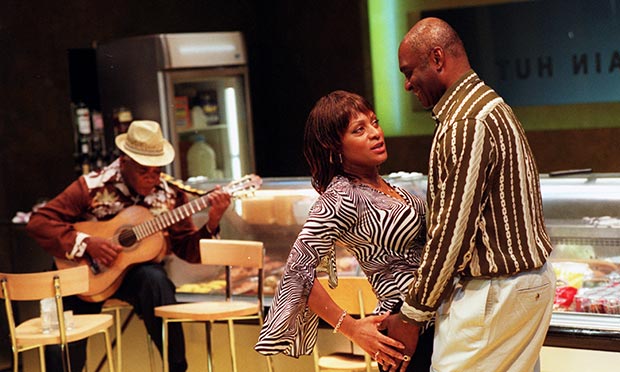
Elmina's Kitchen at the Cottesloe in 2003

Photo from the original production at National Theatre

  •  Use of music helps sense of place and culture, and underscores action

I’d be interested to know how much music was in the script before it was taken into production. There’s a great traditional West Indian music prologue at the beginning of the play that really sets the action up and at the beginning of the second act the cast are all singing as well. There’s also reference to songs and music coming from a TV in the restaurant where the play’s set and it not only helps establish the time and place of the play but it also ends up underscoring the action. All this lifts moments in the dialogue giving it more weight and urgency, and for someone like me who is not West Indian, it helped me get into the play a lot easier. In my play Godless Monsters I’ve used 2 songs but the director has put in some more, and at one particular moment she’s cut text in favour of using a song to underscore action as she incorporated 2 scenes in one, splitting the stage action so 2 scenes happen at once. In this instance the prologue sets up the show well, and I would say the music sections are essential to the piece. It’s definitely a device to look at using if you haven’t yet, and is one I’d definitely use again.

 April’s playwright

"Danai Gurira 0001" by Tristan Loper - Own work. Licensed under CC0 via Wikimedia Commons.

Danai Gurira 0001” by Tristan LoperOwn work. Licensed under CC0 via Wikimedia Commons.

Well there was a lot to take from Elmina’s Kitchen and I’ll be thinking more about the devices used going into my #TryptychChallenge project that I’m working on.

You may know her from Walking Dead, but I am seeing Danai Gurira’s play Eclipsed at the Gate Theatre this month so she will be my April playwright. It’s being billed as a strong female play set in Liberia, so I’m very interested to see how it works!

Posted in Culture, Inspiration, Script, Theatre, TV, Uncategorized, Writing | Tagged , , , , , , , , , , , , , , , | Leave a comment

4 STARS for #GODLESSMONSTERS on it’s first night in front of an audience!

I’ve never had a proper review before and I didn’t realise that reviewers had been invited as we were only showing the play at the New Diorama Theatre for 2 nights. But one reviewer came along from The Public Reviews who gave it 4 stars:

 ‘Avery’s tale has a lot of interesting points to make about the way people use religion to get what they want, using a veneer of virtue and morality to hide their true purpose.’

To read the full review click here


We have 3 more showings of the play at King’s Head Theatre. Please come along if you can!

Posted in Culture, Script, Theatre, Writing | Tagged , , , , , | Leave a comment

This play is a time bomb #godlessmonsters #rehearsaldiaryday1

bomb-clipart-bomb2

‘My play is no different to any other play: it’s a time bomb that starts to tick from the moment the first action is initiated, from the moment that desires are heightened, characters cross and explode as they flounder to make sense of their world where only one can survive. It’s a look at how we become who we are, what forces win us over and how we get what we want.’ (From my notes from rehearsal)

I spent my morning in rehearsals today for the world premiere of my play Godless Monsters, attending the first ever read through of this new draft of the script and then watching an initial staging of the beginning of the play. It wasn’t until I heard it read aloud in its newest incarnation that I realised that this play, like all plays I guess, is a ticking bomb. I love theatre that moves quickly, holding the audience in its spell until it spits them out the other side, depositing them limp, exhausted and with a fresh view of how the world could be. This play however takes place mainly in Africa, we’ve had the amazing Mikey Brett make us a puppet goat and I left rehearsals just as they were going to learn some songs, so maybe it is different from any other play.

‘…Characters move like chess pieces through a world that looks like ours but isn’t. They’re people caught in a ring of deep desire unable to think of any other way to fulfil themselves than the actions that spring to mind after tensions hit a fever pitch.

Godless Monsters is my attempt at looking at how you find your voice and room for yourself in a world where your voice has no assumed authority, where you have to make your dreams happen or else they’ll be swallowed up in someone else’s dreams or worse, just forgotten, ignored. Where the people who are in charge can’t be trusted to look after you. It’s dog eat dog out there, didn’t you know?’ (More from my notes from rehearsal)

Chatting to the brilliant cast and director today it reminded me how much of a private world the play feels when you’re working on it in your writing room and what a public form of art theatre actually is. I’ve been working on this piece for about 3 years and when talking about it, it still surprises me how many different influences I’ve brought together to make this work.

We need stories that challenge who we think we are, how we think the world works and I feel that as much now as I did on that weekend in June a few years ago when I just had to write what has become this play. I hope it adds something to the conversation of how we see ourselves, of how we become who we are. I mean how far would you go to protect your spiritual calling? What would you do to protect the one thing you’d found that finally gave your life purpose and made you make sense?

Come see for yourself and be a part of this conversation.

Piqued Production presents the world premiere of Godless Monsters by Lucy Avery, 29 & 30 March, 7.30pm, New Diorama Theatre, 25 April, 2 & 7 May, 3.00pm, King’s Head Theatre

Posted in Culture, Script, Theatre, Writing | Tagged , , , , , , , , , , , , | Leave a comment

February’s playwright: Jennifer Haley #12newplaywrightsin12months

Jennifer_Haley

Jennifer Haley

Jennifer Haley isn’t a playwright I’d heard of before, but with the rave reviews of her play The Nether that’s transferred from the Royal Court to the West End I couldn’t pass up the opportunity to see what I could learn from watching the show. The play actually premiered at the Kirk Douglas Theatre after winning the 2012 Susan Smith Blackburn Prize. Haley trained under playwright Paula Vogel at Uni and writes for theatre as well as for a Netflix series called Hemlock Grove.

I researched her a little before writing this piece (there’s a really great interview here) and found that one of the things she took from her training was to always push herself in what she writes and to have a go at writing what you hate! This way you learn to stretch yourself and really explore your potential whilst not staying wedded to the one genre you think you can write #goodgeneralwritingtip

CSI-LV_main

  • Police investigation format helped to introduce you to the world of the play

So The Nether came about because Haley hated the programmes that feature the predictable police procedural format (like CSI) and her ideas just grew from there. She definitely followed the format well and introduced the audience to the future time period the play is set in and the Nether (the name she gives what the internet has become in this future) through drip feeding the information through the police investigation interviews that make up a lot of the piece. It was a very clever way to also see the characters responding to difficult questions which told you a lot more about them in a short period of time, whilst also holding the story back as it followed the progression of the investigation.

Sherlock-holmes-and-magnifying-glass

There were 2 lovely monologues towards the end of the play that gave a snapshot into the back stories of the 2 main characters. Within the format she’d chosen it was right for them to be short, but I wished that there had been more of them so I could’ve gotten under the skin of what really motivated these characters to do what they did. The play was well balanced and I can see why it’s getting rave reviews and it’s a really interesting look via a police procedural format to something that’s more questioning about human relationships, but I would’ve liked to have got closer to the characters.

the_birdcatcher

  • Interesting use of multiple time frames

This won’t give anything away as to the plot and resolution, but Haley cleverly uses multiple time frames to at first keep the audience behind the narrative so you’re intrigued to get into the world of the play, and then we’re ahead of what’s happening as you start to understand the time shifts, and then she turns it on it’s head when you realise which time frame has driven the story on. In my play The Birdcatcher I work with 3 distinct time frames and this has definitely given me more confidence in experimenting with that more and even interspersing the scenes more directly. It was also a clever way to keep the audience engaged. Definitely something I’ll be playing with more.

The Nether 2

  • Character doubling

Something unique to this piece is that both the virtual reality world and the present world are held together in one set and at one point both worlds hold together happening at the same time. The interesting thing I found with seeing the virtual reality is that rather than the actors doubling up as more than one character, these characters became someone else whilst in the Nether playing across gender and across race which is something I’ve not seen before. Seeing this virtual world and character play in front of you was very powerful and a great device to add gravity, mystery and complexity to the story. Unless I’m writing about virtual reality or maybe a party where the characters leave who they are at the door, I can’t see a way of experimenting with this device! It brought a richness and visual depth to the story though and is definitely something to play with if you can figure out how!

March’s Playwright

Kwame_kwei_armah

I had a very busy February moving flats so apologies for this late entry, however when clearing out I found a copy of Elmina’s Kitchen by Kwame Kwei-Armah which I’ve always meant to read but haven’t, so he will be my March playwright.

Posted in Culture, Inspiration, Script, Theatre, TV, Uncategorized, Writing | Tagged , , , , , , , , , , , | Leave a comment

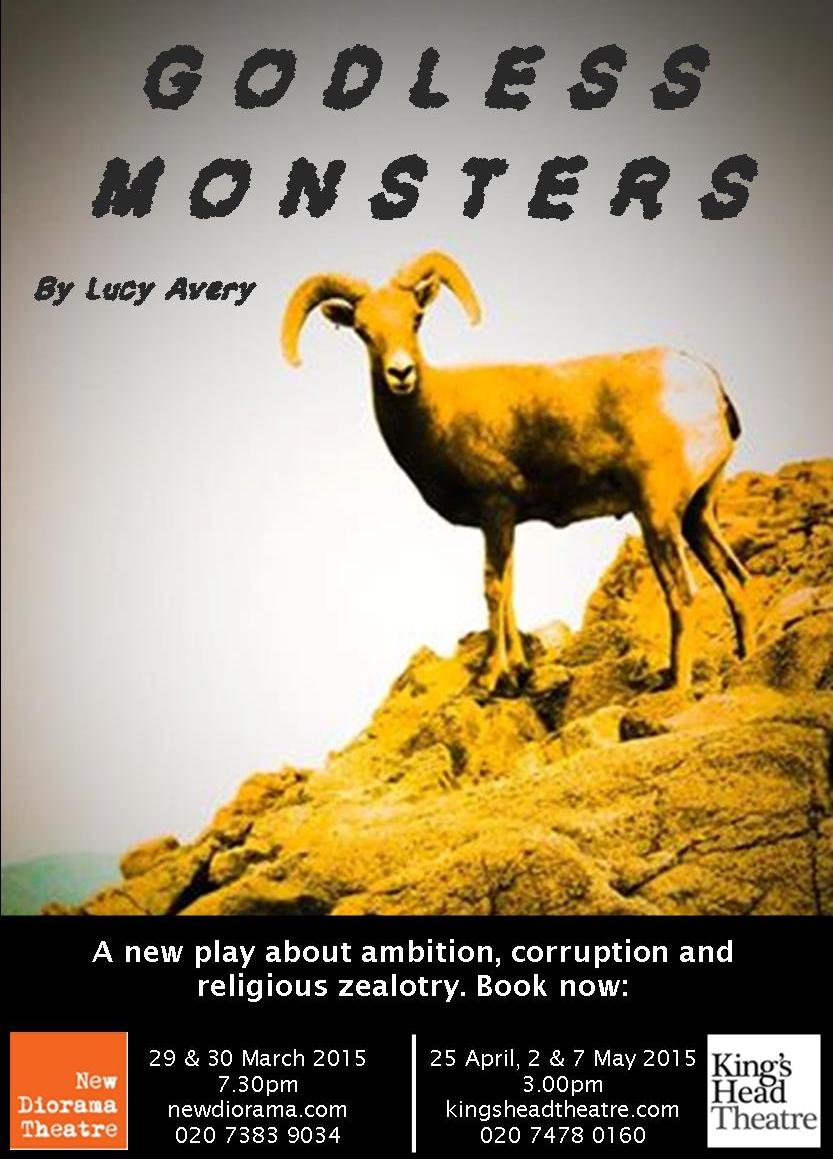
Announcement: See Godless Monsters at New Diorama Theatre and King’s Head Theatre this Spring!

Godless Monsters Eflyer

‘I place before you the head of my godless enemies. They have tormented me and hated me ever since I wanted to go my own way’ (Extract)

I’m very pleased to be able to announce that Piqued Productions will be presenting the world premiere of my new play Godless Monsters!

Book now to see it at the New Diorama Theatre 29th & 30th March or at the King’s Head Theatre as a part of their Without Décor programme on 25th April, 2nd and 7th May 2015

In an intimate exploration of ambition, corruption and religious zealotry, Godless Monsters looks at the power of belief in the face of betrayal. When Esther, a 12 year old Zambian, escapes an arranged marriage by getting a job at her local church she believes that God has blessed her life. But when Gray, the new English missionary, discovers Esther’s secret and threatens to take away everything she’s worked for unless she submits to his demands, she’s faced with the dilemma of how far should she go to protect her spiritual calling?

After developing the script with Jennifer Lunn at Culturcated Theatre Company and working on it during a residency I was awarded by The Expansionists at 57a, Piqued Productions who are a newly formed company that produce work featuring women centre stage, tackling important questions and provoking discussion, will be using puppetry and highly visual storytelling to bring to life this tale where nothing is quite as it seems.

Godless Monsters

Posted in Culture, Inspiration, Script, Theatre, Uncategorized, Writing | Tagged , , , , , , , , , , , | Leave a comment

January’s playwright: Jack Thorne #12newplaywrightsin12months

Jack Thorne, writer

Jack Thorne, writer

“I think I started writing plays as a way of expressing the things I couldn’t say”

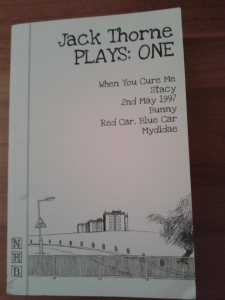
This quote from Jack Thorne‘s introduction to his recently published Plays One seems like a good enough reason to start writing plays if you ask me, and one I can personally relate to. My quest to read and see more plays by contemporary writers has started with Thorne who may be more well known for writing for TV, even though he started life as a playwright.
20150107_222320

I only managed to read 2 of the plays from this collection this month, but both deal with trauma (a subject I’m quite interested at the moment) and were interesting comparisons: When You Cure Me is a full length piece looking at the affects of rape on a teenage girl over several months and Red Car, Blue Car is a shorter piece commissioned by Bush Theatre that looks at the immediate after affects of a road accident.

I won’t give you a synopsis as you should definitely read these plays for yourself, but here are some things I noticed about his style that I may experiment with in my own work:

  • The private made public as show don’t tell & pack a punch at the end
Skins TV show, written by Jack Thorne

Skins TV show, written by Jack Thorne

Just by reading his first play (although he admits in the introduction that he wrote about 20 plays before this one was taken up) you can see why Thorne was picked up for TV (Skins pictured is one of his TV series). He does pained adolescent awkwardness and intimacy very well in When You Cure Me and you can imagine it may translate to the small screen even better than it does in theatre. There are some beautiful moments where very intimate, personal actions are made public for the main character and they tell you a lot about the character from the very beginning of the scene before she’s even said anything. A good lesson in show don’t tell that hotlines you into the world of the play. It also engages you emotionally when reading and I imagine this would have been amplified when staged.

These actions didn’t feel that theatrical though (in terms of devices used) but in Red Car, Blue Car Thorne uses the device of 2 characters delivering interconnected but separate monologues to give an unexpected punch at the end when both stories come together. A great theatrical device for helping a short piece stay in the audience’s mind long after it’s left the stage, and it stayed with me far longer than the other piece (though that may tell you something about my taste for punchy pieces rather than longer intimate ones).

  • Stage directions -‘Nothing’ gives space
Harold Pinter, playwright, actor, poet and activist

Harold Pinter, playwright, actor, poet and activist

Now I know that sometimes stage directions aren’t written in the original script and are worked through rehearsal and written when the show is first performed, given to the publisher for the printed edition by the writer or even the stage manager. However, the stage directions included in When You Cure Me were really interesting. He uses ‘Pause‘ and ‘Silence‘ as maybe Harold Pinter (pictured) might do, he uses ‘Beat‘ too (which is usual enough) but also ‘Nothing’. In fact one stage direction reads ‘Nothing. A big crowd of it. Nothing. More nothing.‘ which I thought was a genius way of giving both the actors space in the script to really feel what was going on for their character at that moment, and also for the audience to digest what they’ve witnessed. Very clever. And when stage I know it would be full of tension. 🙂

  • Well-observed speech
Emile Zola, writer and developer of theatrical Naturalism

Emile Zola, writer and developer of theatrical Naturalism

Both pieces were rooted in naturalism/realism and my other take away was how he captured awkwardness between exchanges and embarrassments when dealing with his teen characters.  It meant you immediately bought into the characters and their stories.

Another thing Thorne says in his introduction is

“Writing plays was a way of winning the conversation by controlling the conversation”

and reading his dialogue and monologues made me less afraid to use half sentences or misunderstandings as conversation. He used everyday words rather than poetics to build images and situations, especially in the monologues, which was a reminder to me that real poetry in theatre can come from acute observations of the everyday rather anything that sounds like poetry.

So where next? 

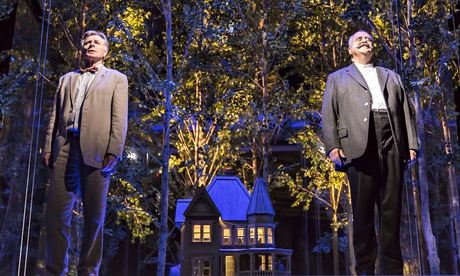
The Nether by Jennifer Haley

The Nether by Jennifer Haley

So I’ve learnt quite a bit from Jack Thorne, and I may start to experiment with this new inspiration in my part of our #TriptychChallenge. I’ve had loads of suggestions about other writers to look at from the Facebook group Playwrighting UK and The Book of Maev blog but February’s playwright is going to be Jennifer Haley as I’m seeing The Nether in the West End next month. It’s had great reviews and I’ll be seeing it and then reading the script (if I can get hold of a copy) so I can compare the text on the page to the production.

I’ll let you know any insights next month. 🙂

Posted in Culture, Inspiration, Script, Theatre, TV, Uncategorized, Writing | Tagged , , , , , , , , , , , , , | Leave a comment